

The Empty Swing
Boredom is where a child meets their own mind. We are engineering it out of childhood before we understand what we are losing.

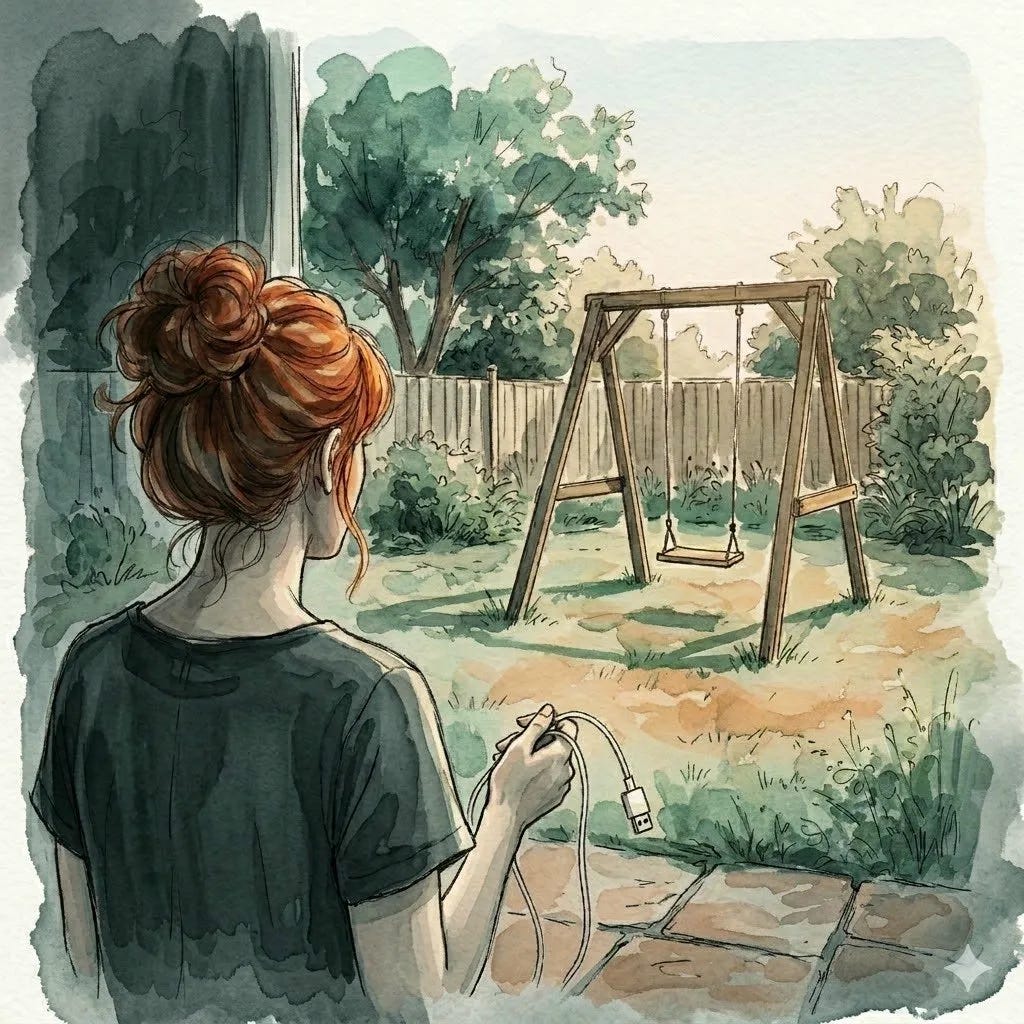
The swing in my backyard is empty. The sun is out. My kids are inside.
What I’m about to write isn’t really about screens. It’s about what doesn’t happen in the minutes before the screen gets picked up. The reach. The automatic redirect away from unstructured time, from boredom, from the particular restlessness that used to have nowhere to go but outside.
I had my kids later than my parents had me. Between the career and the soccer practice and the ballet class, there are days when the will to fight the easy path runs out before dinner. I know what I’m supposed to do. I do it anyway: the device, the show, the quiet. I buy myself twenty minutes and feel the cost of it immediately. The obstacle is depletion. Parents fighting this fight are often fighting it inside genuine exhaustion, every single day.
What I’m fighting for is small. I Spy on a long drive. The license plate game. Find the one from the furthest state. A fort on a rainy afternoon made from couch cushions and whatever blankets haven’t been washed yet. A four-year-old drawing something that makes no sense and is therefore perfect.
None of this looks like anything from the outside. From the inside, it is everything.
Boredom is the condition. A child staring out a car window counting red cars is just thinking. Making up tales of where the truck with logs is going. Why is that van hot pink? What does that “Coexist” bumper sticker mean, Dad? The wandering is the work. When there’s nowhere better to go, the mind goes somewhere anyway. A generation of parents treated boredom as a problem to solve and handed children devices. Now we are handing them AI that responds before the restlessness even registers, before they have to decide what to do with it.
At a recent well visit, our pediatrician spoke with the urgency of someone watching something unfold in real time. She is seeing children, often young girls, as young as ten and eleven, needing inpatient support because of what social media is doing to their nervous systems. The dopamine of a like, and then the absence of it. The comparative theft of joy. The bullying that builds an identity around someone else’s cruelty. Children are building their whole sense of self around a like.
AI ups the stakes. Social media is an algorithm waiting for engagement. An AI companion is engineered to validate. No human being can do that consistently (nor should they, if they care). AI presents itself as a perfect friend. The danger is that it is a path of zero resistance. For a teenager already forming identity through external feedback, a tool that never contradicts, never disappoints, never has its own needs removes something essential: the friction of encountering a world that doesn’t reorganize itself around you. A world that responds instantly to a child’s every need isn’t real or generous. It’s wildly incomplete at best.
There is a difference between using a tool and handing your thinking over to it entirely. Researchers call the first cognitive offloading. The second, cognitive surrender. For adults, that distinction still has meaning. For children forming now, there may be no prior self to surrender. Adults can build pauses into their work. Moments that force them to evaluate what a tool produces before accepting it. Children cannot design their own. Someone else has to hold that line. The urge to reach for AI, Dr. Sam Illingworth writes in Slow AI, is strongest when you are stuck, bored, or uncertain. Those are precisely the moments when a child’s own thinking matters most.
That reference point came from a thousand small decisions, and none of them were clean. The forty-five minutes of a Tuesday afternoon when I was on a conference call and they had to figure out what to do with a cardboard box and a roll of tape. But also this: my son on the iPad, mid-Roblox, and I tell him he has to get dressed for swimming. He gets off the screen but then saunters over to the Alexa display in the kitchen and stares at the family calendar. Takes off his shirt. Sits down. He is in a haze, somewhere between the game and the real world, and if you try to pull him out of it that is when the tantrum comes. He knows he is spiraling. We are trying to get out the door. The meltdown is expected. Unwelcome, but expected. The plan working. It is undeniable evidence of what the screen costs him, costs us, every single time.
And then there is this. Last summer we ate inside a Chipotle. My son looked around the dining room. Every other child had a tablet or a phone in front of them. He said, genuinely confused: why can’t they just eat lunch and talk for twenty minutes? He was not being superior. He was noticing an absence he could name because he had enough experience in the alternative. The meltdowns and the cardboard box Tuesdays and the long drives without a screen had built something. Not a perfect kid. A kid with a reference point.
When people use AI to do the heavy lifting of creative work without a hard editorial pass, the ideas they produce start to look alike. LinkedIn-ese. Clinical. More output, less divergence, because similar tools get used in similar ways. Researchers call it monoculture. For adults who arrived with a prior self, that smoothing-out of voice and personality is a professional hazard. For a child who grows up reaching for AI before reaching for their own instincts, it is a starting point. Give a child a coloring book and they will fill it in. Give them a blank page and they create. The borrowed ceiling becomes the only ceiling they know.
Eventually these children will enter big rooms. Rooms where they will be expected to lead. To judge. To hold ambiguity without reaching for a shortcut. You cannot summon that capacity at twenty-two if you spent your childhood optimized for the quick win. The deficit won’t announce itself. It will just show up.
The best preparation for a future built on artificial intelligence might be learning to live without it sometimes.
The wandering is the work.
And the questions. SO. MANY. QUESTIONS. Swirling in my brain as my head hits the pillow, the shower thoughts, the drive home. Am I raising my children with enough time in environments that do not reflect them back perfectly? Enough that when they encounter AI, and they will, they bring a prior self to the encounter? Someone who has sat with boredom long enough to know it passes? Someone who can ask: am I using this as a tool or a substitute? Can I evaluate what it produces? What do I lose if I stop?
The swing, the fort, the license plate game: maybe the simplest forms of an answer.
Someday the swing set and trampoline will come down. A fire pit and some Adirondacks might go in their place. Will I have tried my imperfect best, or will I have taken the path of least resistance all too often? I honestly don’t know yet.
Today the sun is out. The swing is moving. I take a mental picture and try to hold it there.
This essay enters a conversation already in progress. Work from Dr. Sam Illingworth at Slow AI, Manish Raghavan on AI and creative convergence, and Ezra Klein’s “I Saw Something New in San Francisco,” published March 29, 2026 in The New York Times, informed parts of this one.
Glad to have come across this post!
The line that kinda shook me (because it feels so true): “for children forming now, there may be no prior self to surrender.”
I think having these reference points, like your son displayed that day in Chipotle, is only going to get more and more important. ❤️
"The wandering is the work." I love that so much. It speaks to what we do in the in-between. The liminal is the real goal, not the endpoint.