
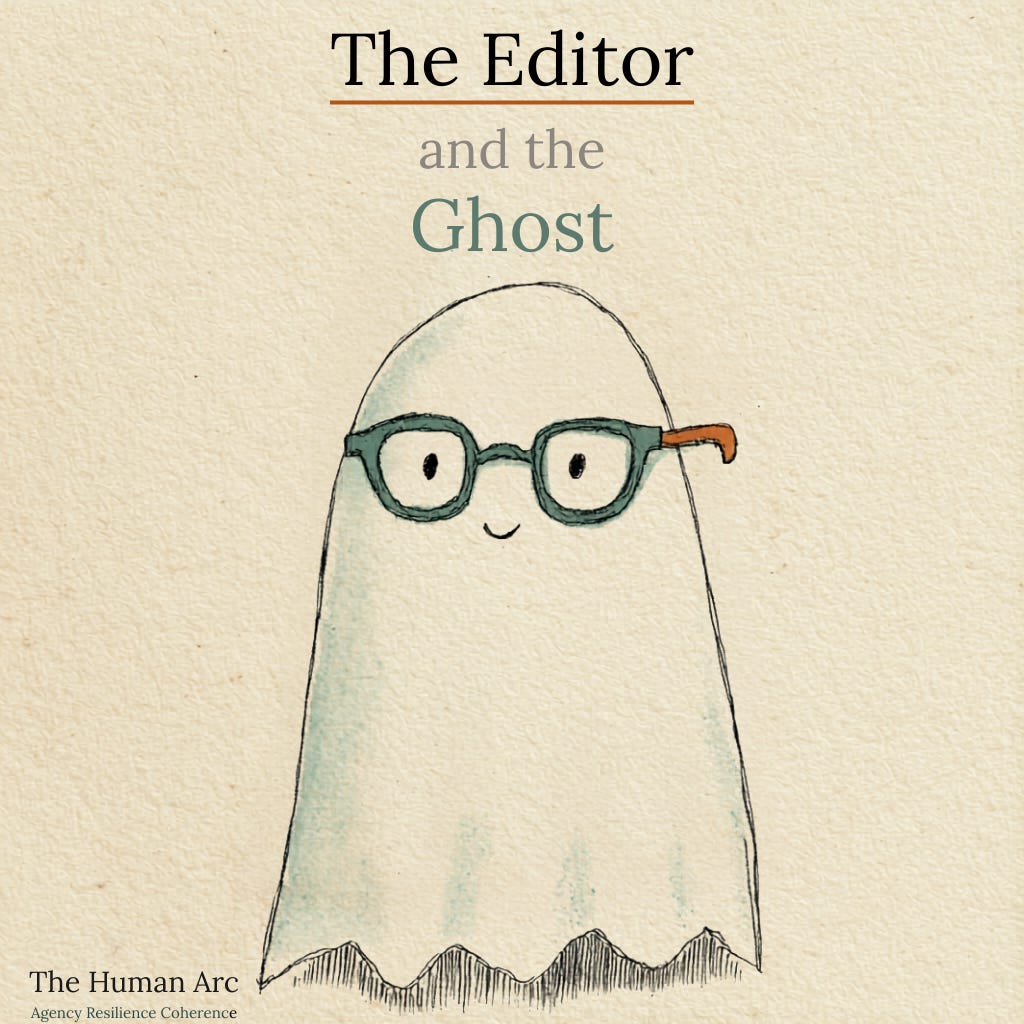
The Editor and the Ghost
On borrowed voice, AI word salad, and who's actually in the room.

All English. My native tongue. And yet…
I read a LinkedIn post three times last week and could not tell you what it said. The words were familiar. The sentences were grammatically intact and totally fine. Something about AI, and inclusion, and the future of work, yada yada. A reflective question at the end, a few hundred reactions. Comments calling it brilliant.
I sat with a feeling I could not shake. It wasn’t confusion exactly… something closer to being gaslit by a paragraph.
This is what The Human ARC keeps returning to: the places where agency quietly slips, where resilience goes untrained, where coherence gets outsourced to something that has never had a thought in its life. This is one of those places.
AI-generated content is not confusing because it is complex. It is confusing because it is formatted like meaning without containing any. It wears the architecture of an insight. Your brain keeps searching for the thing it is supposed to be pointing at and finds nothing. The lights are on, but ain’t nobody home. That is a specific cognitive experience, and it deserves a name.
I am going to call it AI word salad. And I am going to implicate myself before I go any further.
· · ·
I use AI in my writing. I am not going to pretend otherwise as that would be disingenuous, and frankly you would see through it anyway. Which means I may be walking a tightrope of hypocrisy here, and I know it. But there is a distinction I keep coming back to, one that I think matters more than most people realize.
An editor makes you better. A ghostwriter makes you disappear.
When I use AI as a trusted editor, I bring the thinking. The ideas are mine going in: the friction, the argument, the specific thing I am trying to say. That all belongs to me. The AI sharpens the edges, challenges the weak spots, asks whether the logic holds and I come out sounding more precisely myself.
A ghostwriter replaces the thinking entirely. You hand over a prompt. You receive back a persona. The output may be polished, maybe even convincing. But you cannot defend it in a room, extend it in conversation, or build on it the next time because you never actually thought it.
You borrowed the clothes and forgot to get dressed underneath.
I have felt the pull. There have been moments — a deadline, a blank page, a week that took more than it gave — where I could have handed the whole thing over. A few times I let the draft run longer than I should have before pulling it back. The voice that came out was not wrong exactly, it just was not mine. I could feel the seam. The “ick” of outsourcing my thinking in exchange for time.
· · ·
The problem is not only ethical, though it can be. It is practical. But here is where things got genuinely strange…
I watched a comment thread beneath that post. A response arrived, also luminous, also abstract, full of phrases like “opens the portal to our growth and greatness.” The author replied warmly, reflecting the comment back with affirmation. A closed loop. Two systems trained on human approval, performing approval at each other. No one in that exchange was changed. Nothing real was transferred. I was watching MoltBook in real-time. The most human thing about it was that nobody noticed.
AI complimenting AI in a loop. That is not the future of thought leadership. That is its hollowing out.
And this is where I want to talk about your brain, because I think we are underselling the stakes. Your brain is a muscle. Not metaphorically but functionally. The struggle to articulate something you actually believe, to find the precise word, to sit with a half-formed idea long enough for it to become a whole one — that is training. The FLEX. And the inner critic is part of that training. That voice that says this is not good enough, who are you to say this, what if you are wrong… you do not silence it by outsourcing the work. You sit with it. You get familiar enough with its patterns to know when it is protecting you and when it is just noise. And then, as the great philosopher Jay-Z once observed, you brush your shoulders off and keep going. Agency is built in that friction. Resilience lives there. And coherence — the ability to know what you think and say it plainly — is a capacity. Like all capacities, it atrophies without use.
If the thoughts are not your own, what exactly are we building?
· · ·
This is the kind of question I bring into rooms with leaders. Not to shame anyone for the tools they use, but to hold up a mirror to what is actually being produced and who is actually producing it. Four questions I use when the seam starts showing:
Does it sound like something you would say out loud to another person?
Can you argue against it?
Can you make the core idea plain to someone with no context?
And most importantly:Is there a specific human perspective in here, something only you would notice, or did the “I” quietly leave the building?
Run those on anything you are about to put your name on. The gaps are where the real work begins. Welcome them, as the thinking that closes them is the very thing that makes us human.
I use AI and I will keep using it. But I am the one who shows up to the page first, and I am the one accountable for what it says. The editor sharpens what is mine. It cannot manufacture what is not there.
The goal is to make sure you are still in the room when it runs.
Before you publish your next piece, paste your draft into your AI tool of choice and run this…
“Read this as a skeptical human editor. Where does the voice disappear? What sounds like a template? What is the one sentence that sounds most like me — and what is the one sentence that sounds least like me?”
That gap is where the work is.
The Human ARC · Agency. Resilience. Coherence.
This is well said. That uncanny valley of writing. It *feels* right and *seems* plausible but that primordial survival hind brain kicks in, “something isn’t write…” 😏